Week 10: Daniel - part 1
 Of
the two biblical apocalypses, Daniel
and Revelation have a few things in
common. Each book was written in response to a specific crisis - Daniel to the persecution of the Jews by
Antiochus IV Epiphanes in the second century BCE, and Revelation to what the writer believed to be impending persecution
of true Christians by the Roman Empire in the first century BCE. Each text
provides apocalyptic solutions to a crisis. In each, a human seer tells of
visions of the supernatural world. The visions are partially interpreted by an
angel. What occurs in the supernatural world determines what happens in the
human world and in human history. The earthly adversary of God's people (God's
people being the Jews in Daniel and
Christians in Revelation) will be
defeated by God through God's intervention, and God's people will live with God
forever after. Both texts anticipate resurrection, and both attempt to convince
the reader of the same. Because both texts reveal insight into the heavenly
realm and God's decisions, they are considered "divine revelations."1
All of these points should sound familiar since we've talked about them all in
previous lessons.
Of
the two biblical apocalypses, Daniel
and Revelation have a few things in
common. Each book was written in response to a specific crisis - Daniel to the persecution of the Jews by
Antiochus IV Epiphanes in the second century BCE, and Revelation to what the writer believed to be impending persecution
of true Christians by the Roman Empire in the first century BCE. Each text
provides apocalyptic solutions to a crisis. In each, a human seer tells of
visions of the supernatural world. The visions are partially interpreted by an
angel. What occurs in the supernatural world determines what happens in the
human world and in human history. The earthly adversary of God's people (God's
people being the Jews in Daniel and
Christians in Revelation) will be
defeated by God through God's intervention, and God's people will live with God
forever after. Both texts anticipate resurrection, and both attempt to convince
the reader of the same. Because both texts reveal insight into the heavenly
realm and God's decisions, they are considered "divine revelations."1
All of these points should sound familiar since we've talked about them all in
previous lessons.
Daniel:
An Overview
Daniel is considered by
many to be the most unusual book of the Hebrew
Bible (our Old Testament), in part because there are problems with the text
that cannot be easily resolved. It is also a "notoriously dangerous book
that has fueled religious speculation as well as contributing to social unrest
and even revolution," especially during the English civil war, but also at
many other times throughout history. People who believe the world is not as it
should be are drawn to Daniel because
the book shares that same conviction.2
The
book of Daniel severely judges human
rulers and empires, and assumes that people of faith will always and eventually
find themselves at odds with the state, its "political loyalties and
idolatrous patriotism."3 It is a subversive text and leaves no
space for "good citizenship." Daniel
calls for loyalty to God which will result in treason.4
But
this subversiveness raises some interesting questions for us. Although we
usually read Daniel assuming that we
are the underdogs, we must ask ourselves if we are the oppressed, or if, in
reality, we are the oppressors. "If the Christian faith is to be one that
challenges the modern world, then it must accept a certain alienation from the
dominant culture and its religious traditions of dominance."5 Do
we embrace or reject our society and culture? Do we live in the kingdom of God
or in Babylon? If we want to live in the kingdom of God, we must embrace a
theology of Christ over and against culture, especially when culture is based
on the economic abuse of other peoples or nations, or on military might.6 This
is something you might want to think about further.
It
is hard to overestimate the importance of Daniel
to early Jewish and Christian literature. First, in the Hebrew Scriptures, Daniel
is the only text that "contains an explicit expression of resurrection
hope."7 Second, Daniel's
vision of the Son of Man influences the ideas of apocalyptic messianism for
both Jews and Christians. Third, Daniel's
vision of the four kingdoms are reflected and reused throughout Jewish
literature and in the book of Revelation.8
Although one book, the book of Daniel is in two parts. Chapters 1-6
form a prologue to chapters 7-12, while chapters 7-12 form the apocalypse
proper. The first half of the book has 6 stories about Daniel told in the third
person. Chapters 7-12 are Daniel's visions told in the first person.9
At this moment, we're not really concerned about the first six chapters of Daniel, but we do want to take a look at
Daniel's visions so we can try to understand what is going on in them and
compare Daniel to Revelation.
When Was Daniel Written?
 |
| Antiochus IV Epiphanes |
Initially,
we must understand this about the Book of
Daniel--it was not written when it appears to have been written. It appears
to have been written during the Babylonian exile in the sixth century BCE, but
it was not. The Babylonian exile merely creates a literary setting for the
stories. Although parts of Daniel were probably written in the fourth through
third centuries BCE and circulated independently, these writings were redacted
(brought together, edited, added to and finalized) in the mid-second century
BCE. Scholars believe this because Daniel specifically speaks of Antiochus IV
Epiphanes, a Seleucid ruler from Syria, who was responsible for a focused
persecution of the Jews in Judea. Persecution of the Jews under Antiochus began
with the desecration of the Temple in 167 B.C.E., therefore, scholars assume
that the book of Daniel came into its final form around the mid 100s BCE.10
Understanding
when Daniel was written makes another
issue clear: although Daniel appears
to be making predictions about the future, the writer (or redactor) of Daniel already knows about what Daniel is predicting, because the
predicted events occur in the writer's past. It would be like one of us writing
a novel about the Civil War and making a character accurately predict the
future. We know what happened, so our character would appear very wise or
spiritual indeed when his or her prophesies came true. The writer or redactor
gives accurate predictions to Daniel as a literary character. However, the
writer does not know what will occur in his own future. When the writer tries
to do this, he errs in inaccurately predicting the end of Antiochus' reign and
death. This inaccuracy helps scholars pinpoint a short span of several years
when Daniel most likely first
appeared as a text in its entirety. The change from accurate predictions to
inaccurate ones indicate that Daniel
appeared as a completed text slightly before 164 BCE.9 This puts Daniel
smack dab in the middle of the Jewish persecution under Antiochus IV Epiphanes,
after the desecration of the Temple but before the death of Antiochus.11
Why
is this so important? Because if apocalyptic literature was written as a
message of hope as well as to convince a community of something, then the
assumption must be made that Daniel is a text that spoke to the
writer/redactor's contemporary Jewish community which found itself under
persecution in the mid-second century. We will approach our survey of Daniel
with this in mind.
Book
of Daniel: Chapter 7
 When
we look at chapter 7 of Daniel, were
confronted with some interesting ideas. Some of Daniel's visions are actually
explained later on in the same chapter, so trying to decipher what these
visions are becomes a little bit easier. Of course, scholars cannot determine
exactly what everything means because small pieces of history remain unknown to
us, but they do have a pretty good idea based on what appears later on in the
writing. Let's quickly go through Chapter 7 and explain what some of this
vision more than likely means. We won't discuss everything that happens in this
vision but we will hit the main ideas.
When
we look at chapter 7 of Daniel, were
confronted with some interesting ideas. Some of Daniel's visions are actually
explained later on in the same chapter, so trying to decipher what these
visions are becomes a little bit easier. Of course, scholars cannot determine
exactly what everything means because small pieces of history remain unknown to
us, but they do have a pretty good idea based on what appears later on in the
writing. Let's quickly go through Chapter 7 and explain what some of this
vision more than likely means. We won't discuss everything that happens in this
vision but we will hit the main ideas.
One
of the first things we encounter in chapter 7 are four winds of heaven stirring
up out of the sea. More than likely the four winds represent a chaotic world
state. Winds usually come from one direction,12 but here are
presented as coming from all four directions at once. These winds may set the
stage by presenting something out of the ordinary, something that is not normal,
blowing up from the sea. The sea is also something else that we need to pay
attention to. For the Israelites, the sea was not something to go to for a
relaxing time. The ocean was viewed as dark and filled with beasts and
creatures that made them afraid. The Israelites are not generally thought of as
an ocean-going people although at times in their past they had used the sea for
trade. The ocean was associated with foreboding and darkness. Heavenly winds
stirring the seas created a chaotic and fearful setting, perhaps alluding to
spiritual/mythical warfare.13
If
you turn to verse 15 of chapter 7, you will see Daniel's vision of four beasts
coming from the sea. The fourth beast is described, as are the horns. The
fourth kingdom is of great concern because it is the kingdom that the writer
lives in, complete with a meniacle king bent on either subduing and changing
the Jews or destroying them.14
The Four Beasts or Four Kingdoms
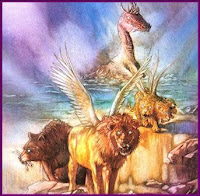 |
| The Four Beasts of Daniel |
If
we turn back to the fourth verse of chapter 7, we will see the beginning of
descriptions concerning the four beasts who arise from the sea. "The sea
is the enemy, chaos, the realm of Leviathan."15 Therefore the
beast are interpreted as world powers, empires or kingdoms associated with
chaos and at odds with the power of heaven. The beast arise one by one to do
battle and theologically represent the battle between good and evil.16
The
first beast is a lion with eagles wings who achieves a human mind. This first
beast is thought to represent the Babylonian empire or kingdom. Winged lions
are well known from Assyro-Babylonian art.
The
second beast, appearing as a bear, represents the Midian empire or kingdom.
This beast is associated with threats to human life from wild animals, and is
already devouring something because it has ribs in its teeth. The question that
arises concerning this beast is, who is telling the bear to devour many bodies?
Many presume that this is being accomplished at God's command, however, God
never speaks in this vision. If the writer is implying that God is the one
commanding the bear, then he is also implying that the destructiveness of this
empire is also under God's direction.
The
third beast appears like a leopard and represents the Persian empire or
kingdom. It is unknown what the four heads and four wings represent but it is
believed they somehow represent the four Persian kings--Darius, Cyrus, Xerxes,
and Artaxerxes. The text states that dominion, or sovereignty, is given to the
leopard. This image seems to be more neutral than the other three, however,
this leopard is hardly benign.17
The
last beast represents the empire or kingdom of Alexander the great. It is it is
described as, "terrifying, dreadful, exceedingly strong, and
devouring," and is therefore different from all the other beasts that have
preceded it in regards to its level of malevolence. This beast has 10 horns,
believed to represent the line of rulers in the Seleucid dynasty that ruled
Syria after the death of Alexander. The first Seleucid kings had coins decorated
with horns, symbols of their "divine" power. Also, verse 24 states
that the ten horns represent ten kings, with the eleventh horn representing one
that is different from the others.18
 |
| The Little Horn |
As
Daniel watches, a little horn appears and uproots three other horns. This horn
is different from the others not simply in appearance, but in that it has
powers the other horns do not. This horn has eyes and speaks arrogantly. There
is little doubt that this horn represents Antiochus IV Epiphanies. Although it
is unknown exactly who the three plucked out horns represent, the most likely
suggestion is that these represent the three men in line for the throne upon
the death of Antiochus III--Seleucus IV Philopater and his sons, Demetrius and Antiochus.
We know that Antiochus IV killed his young nephew Antiochus. History is unclear
whether Antiochus IV had anything to do with the death of the other two. Even
though Christians would later interpret Rome as the fourth and final beast,19
it is pretty clear that it represents Alexander's empire and the Seleucid
line of kings, culminating in Antiochus IV.20
As
we look further in this chapter, we see in verse 21 the little horn has not
only gained great power, it wages war against the holy ones and soon starts to
prevail over them. This statement marks the beginning of Antiochus IV
persecution of the Jews. In verse 25, he speaks against the Most High and
attempts to change the sacred seasons and law. It is known that Antiochus IV
banned the observance of the Sabbath and Jewish feast days.21
The
Fifth Kingdom
 Because
it is not specifically stated, we should note that there is actually a Fifth
kingdom that follows the other four. The symbol for this kingdom is a human
figure. This contrasts with the first four kingdoms who are represented by
animal symbols from the sea, or abyss, and is associated with the heavenly
realm.22 Although verses 9-14 have to do with heavenly judgment, not
all of the symbolism is well understood. Why is thrones plural? Perhaps a
heavenly counsel is suggested. What is clear is that we are in the realm of
political sovereignty once again, but this throne room is the one that
possesses the true authority. The one referred to as, "Ancient of
Days" has the greatest authority. His description resembles that of the
Canaanite God, El, as well as other biblical images representing God. Thousands
attend him, many more than attended Belshazzar in an earlier story. A court is
held and the beasts are dispatched. The fourth beast with the horns is not only
dispatched, but is immediately burned in judgment. Take note that there is no
emphasis on a Great Battle; when the ancient of days arrives, judgment is dealt
out. (Likewise note that in the book of Revelation, the "Great
Battle" is also easily missed because it is not the emphasis of the text,
although modern Christians seem to try to make it so.) Those not destroyed or
allowed to live without power because a "Son of Man" is given
authority to rule, and those whom he rules over follow his wishes. New
Testament writers drew on this image as a powerful authority under God.
Irrespective of the precise origin or meaning of the "Son of Man"
figure, what is important is that he is a heavenly representative, appointed by
the Ancient of Days. This person comes from heaven but rules as an earthly
figure.23 Some scholars believe this figure represents the whole of
Israel24 and current day readers assume this figure is Jesus.
However, the majority of scholars believe this figure represents the Angel
Michael, a figure who does battle for Israel in later visions. Michael is also
well known in the New Testament (see Matt 16:27; 25:31; Rev 12) and in the Dead
Sea Scrolls, so he was known to ancient believers. It is through this person
that heaven claims the right to rule on earth.25
Because
it is not specifically stated, we should note that there is actually a Fifth
kingdom that follows the other four. The symbol for this kingdom is a human
figure. This contrasts with the first four kingdoms who are represented by
animal symbols from the sea, or abyss, and is associated with the heavenly
realm.22 Although verses 9-14 have to do with heavenly judgment, not
all of the symbolism is well understood. Why is thrones plural? Perhaps a
heavenly counsel is suggested. What is clear is that we are in the realm of
political sovereignty once again, but this throne room is the one that
possesses the true authority. The one referred to as, "Ancient of
Days" has the greatest authority. His description resembles that of the
Canaanite God, El, as well as other biblical images representing God. Thousands
attend him, many more than attended Belshazzar in an earlier story. A court is
held and the beasts are dispatched. The fourth beast with the horns is not only
dispatched, but is immediately burned in judgment. Take note that there is no
emphasis on a Great Battle; when the ancient of days arrives, judgment is dealt
out. (Likewise note that in the book of Revelation, the "Great
Battle" is also easily missed because it is not the emphasis of the text,
although modern Christians seem to try to make it so.) Those not destroyed or
allowed to live without power because a "Son of Man" is given
authority to rule, and those whom he rules over follow his wishes. New
Testament writers drew on this image as a powerful authority under God.
Irrespective of the precise origin or meaning of the "Son of Man"
figure, what is important is that he is a heavenly representative, appointed by
the Ancient of Days. This person comes from heaven but rules as an earthly
figure.23 Some scholars believe this figure represents the whole of
Israel24 and current day readers assume this figure is Jesus.
However, the majority of scholars believe this figure represents the Angel
Michael, a figure who does battle for Israel in later visions. Michael is also
well known in the New Testament (see Matt 16:27; 25:31; Rev 12) and in the Dead
Sea Scrolls, so he was known to ancient believers. It is through this person
that heaven claims the right to rule on earth.25
In
verses 15 to 18, Daniel is distressed by the visions and is therefore given a
simple summary of the vision. The gist of it is this: earthly powers will
arise, God will conquer them, and God's reign will last forever. The fate of the
holy ones reflects the fate of the Jewish people themselves. Although it
appears that the fourth beast is about to conquer the holy ones, the holy ones
will triumph and rule in God's everlasting kingdom. All nations will bow to
them. This final kingdom will be one of peace and worldwide healing. Enemies
will worship together and share equally in the blessings of God, side by side
with the Israelites.26
Thinking
About It
We'll
talk about the last remaining chapters of Daniel in the next posting. If you haven't
already, read chapter 7-14 of Daniel. What do you find that supports what we've
talked about concerning apocalyptic literature in general. You should see
apocalyptic themes present throughout the last 6 chapters of Daniel. What ones
are the most obvious? Was anything in today's posting new for you? Post your
thoughts, ideas or feelings and please feel free to comment on someone else's
posting.
I'll
attempt to cover the remaining chapters of Daniel in the next lesson, unless
they become to unwieldy. The goal is to progress to Revelation, the heart of
our study. Please encourage each other to continue with this study. Our next
lessons will hopefully be interesting as well as enlightening. Notes
1Murphy, Frederick J.
"Introduction to Apocalyptic Literature," The New Interpreter's
Bible, Vol. VII. Nashville: Abingdon, 1996. p. 8.
2Ibid, 33.
3Ibid, 34.
4Ibid, 34.
5Ibid, 34.
6Ibid, 34.
7Carey, Greg. Ultimate
Things. St. Louis: Chalice Press, 2005. p. 38.
8Ibid, 38.
9Murphy, 8.
10Meeks, Wayne A. et
al, editors. The HarperCollins Study Bible. New York:HarperCollins,
2006. p.1168-1169.
11Meeks, 1168-1169.
12Ibid, 1182.
13Murphy, 100-101.
14Meeks, 1168-1169.
15Murphy, 101.
16Ibid, 101.
17Ibid, 102.
18Meeks, 1183-1184.
19Murphy, 102.
20Meeks, 1183.
21Ibid, 1183-1184.
22Ibid, 1183.
23Murphy, 103-104.
24Meeks, 1183.
25Murphy, 104.
26Ibid, 104-106.
 Theological Worlds tells us there are five basic "worlds" of spirituality from which we all operate. It assumes that Christians pos-sess a basic, core set of beliefs. Theological Worlds shows us that even though we all possess these core beliefs, individuals empha-size, or hold some beliefs as more important than others. For example, one person may place an emphasis on transformation through prayer, while another emphasizes justice. No world is right or wrong, but our functional theology, that is, how we live out our beliefs in the world, are based upon our own preferred theological world. Knowing this can help us understand that even though we are the Church Universal, we’re simply not always going to see eye to eye. Here’s another example: one group in a congregation might believe a sum of money should be used for the glory of God to restore stained glass windows in the sanctuary, while a rival group may want to use that money to send a group for Africa to build a new well. Again, neither group is right or wrong; they are merely trying to live out their functional theology based on their own theological world as best they can.


